
What operational chaos actually looks like
Operational chaos doesn’t look like a mess.
It looks like a business that can’t move without one person.
Operations is what keeps your business running when you’re not involved.
If that’s not happening, you don’t have operations.
What chaos actually looks like
I saw this in a growing construction company.
No real office structure.
No central system.
Information spread across different cloud tools and email inboxes.
Everything important lived in the managing director’s head.
At one point, updated construction plans weren’t passed on.
People on-site worked with outdated versions.
Others had different files.
No one knew what was actually correct.
Work didn’t stop.
But it slowed down.
People guessed.
Mistakes became normal.
The real problem
Most people think chaos means bad organisation.
It doesn’t.
It means dependency.
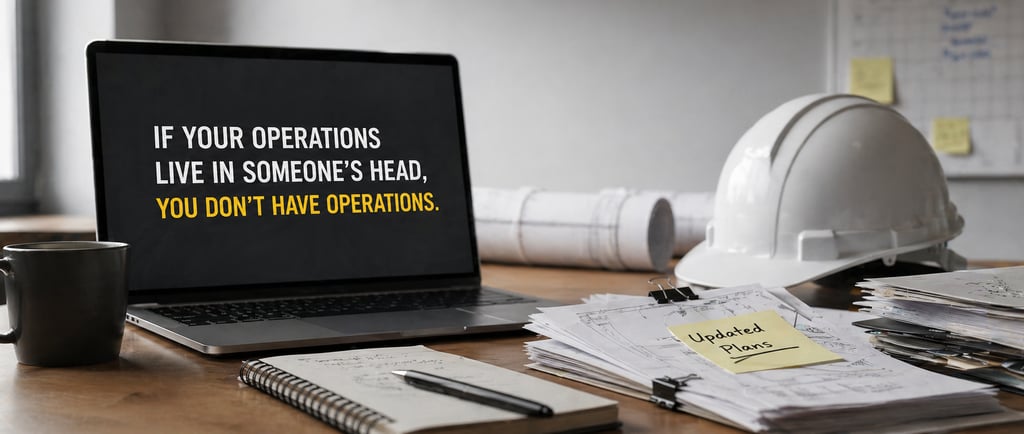
If your operations live in someone’s head, you don’t have operations.
This is what it looked like day to day:
Constant back-and-forth for basic information
Work stopping while waiting for answers
Multiple versions of the same document
No clear structure for where anything belongs
And over time, that creates risk.
Decisions get made on outdated information.
Documentation can’t be trusted.
And the business becomes harder to manage as it grows.
Why this happens
Most growing companies don’t build operations.
They grow into chaos.
Work increases.
People get added.
Tools get layered on top.
But no one defines:
Where information lives
How work should be structured
Who is responsible for what
So everything defaults to the founder or managing director.
What actually fixes it
This wasn’t solved by adding new tools.
It was solved by building a system.
The focus was simple:
Separate company and project data
Define who has access to what
Create a structure that works now and later
Not just for the current team.
But for the team that doesn’t exist yet.
What changed
The shift was immediate.
Before:
People constantly asked for information
Work paused while waiting for answers
Different people worked with different versions
After:
Information had a clear place
People could find what they needed
Work moved without constant approval
The managing director stopped being the bottleneck.
And the business started to run without constant input.
The takeaway
Operational chaos isn’t a productivity problem.
It’s a system problem.
If your business depends on one person to function, it’s not built to scale.
It’s built to stall.
Copyright © 2026 aisz. All Rights Reserved
Tools
Quiz: Business Structure
Contact
aisz
hello@aisz.one
Pyla, Cyprus
